> What is the difference between isolation and quarantine?{expander}

Isolation and quarantine are both public health practices used to prevent the spread of contagious diseases, but they apply to different circumstances based on the person's health status and potential exposure.

  • Isolation is for people who are confirmed to be sick with a contagious illness (or have tested positive, even without symptoms) to separate them from healthy people. The goal is to prevent a known infected person from transmitting the disease to others.
  • Quarantine is for people who may have been exposed to a contagious illness but are not currently showing symptoms. The purpose is to restrict their movement to see if they become sick, thus preventing potential "silent" spread of the disease before symptoms appear.


> What should I do if I think I have been exposed to someone who has measles?{expander}

Students and employees who have documented immunity to measles do not need to quarantine after exposure to measles. If you later develop symptoms of measles, please contact your healthcare provider.


If you do not have documented immunity to measles AND it has been less than 72 hours since you were first exposed to measles, you may want to consider a strategy called post-exposure prophylaxis. In this situation, if you obtain an MMR vaccine within 24 hours, you may be able to avoid quarantine. To determine if you are an appropriate candidate for post-exposure prophylaxis, contact a medical provider or SCDPH (864-372-3133 during regular business hours; 864-423-6648 during evenings/weekends/holidays).


Students and employees who do not have documented immunity to measles and are exposed to someone who has measles must act immediately to protect themselves and others:


1.  Follow quarantine guidelines.

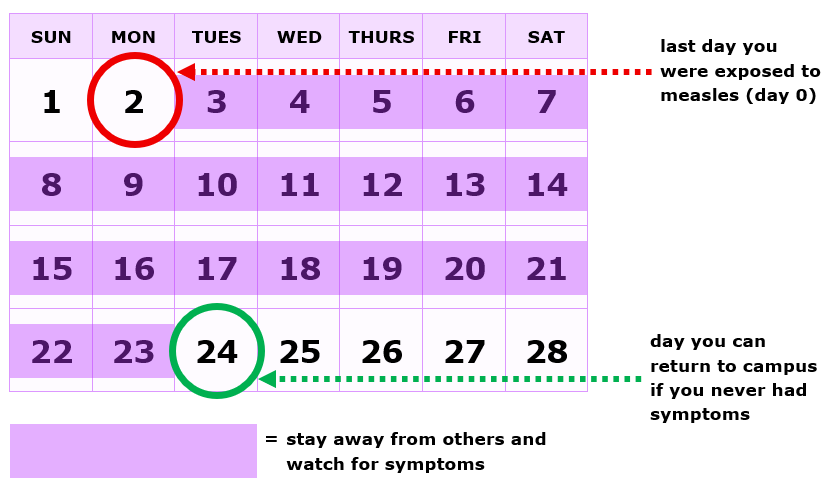
  • You will need to quarantine for 21 days beginning the day after your last date of exposure (see image below). Quarantine during this period is critical.
  • SCDPH will consult with you regarding your specific dates of quarantine. If they have not already contacted you for contact tracing, please reach out to them (864-372-3133 during regular business hours; 864-423-6648 during evenings/weekends/holidays).
  • If you live on campus, call the RD On-Call at 864-621-7114 to make arrangements for quarantine. 
    • Students who live within six hours of campus are asked to go home for their full quarantine period.
    • Students who live more than six hours away from campus should talk to the RD On-Call about their options. Please note that Converse cannot guarantee access to on-campus quarantine housing.


2.  Notify the Wellness Center about your quarantine guidance.

  • The University needs to know about your dates of quarantine in order to ensure that we are preventing any possible spread of the measles virus.
  • Call or email the Wellness Center about your quarantine guidance as soon as possible after SCDPH has clarified the dates of your quarantine.


3.  Stay home and avoid contact with others. 

  • Converse employees should discuss their situation with their supervisor/chair, who will work with employees on a case-by-case basis to determine the best course of action. 
  • You should remain in your home.
  • Do not go anywhere, including to work, school, daycare, or any public areas.
  • Do not have visitors in your home.
  • Separate yourself from others who may live in your home, to the greatest extent possible.
  • Use a separate bathroom/toilet, if available.
  • Do not share eating utensils, towels, bedding, or other items with people.
  • Do not use ride shares or public transportation.
  • If you require food or medications, arrange for contactless delivery.
  • Wash hands often with liquid soap and water for at least 20 seconds.
  • Avoid touching your eyes, nose, and mouth with unwashed hands.
  • Avoid contact with other people; if able, wear a face mask if contact is unavoidable.
  • Pregnant people, infants, and those with weakened immune systems are at highest risk for complications. Avoid all contact with these groups.


4.  Monitor your temperature and watch for symptoms of measles.

  • Use a thermometer to take your temperature twice a day, once in the morning and once at night.
  • Watch out for symptoms of measles, including:
    • Fever over 100.4° 
    • Cough
    • Congestion
    • Red, irritated eyes
    • Rash
  • Notify SCDPH and the Wellness Center if you develop symptoms of measles.


> What should I do if I think I have measles?{expander}

If you suspect you have measles, it is crucial that you act immediately to protect yourself and others:


1.  Call your healthcare provider to consult about your symptoms and make arrangements for testing.

  • Call BEFORE entering any healthcare setting, including the Wellness Center. Your provider will need to make arrangements to prevent exposure to others.
  • Weekdays: Call the Wellness Center at (864) 596-9258 and request a virtual appointment. The nurse practitioner will assess your symptoms and determine if you would benefit from testing for measles.
  • Evenings/weekends: Consider reaching out to a provider who offers telehealth services for guidance. Two options in the Upstate include:
  • Your provider may order lab tests (throat/nasal swab and blood test) to confirm measles. In some cases, SCDPH may send a provider to your location to complete testing.
  • If you do not wish to see a medical provider, please notify SCDPH (864-372-3133 during regular business hours; 864-423-6648 during evenings/weekends/holidays), who may be able to arrange for testing and can help to track others who may have been exposed.


2.  Follow isolation guidelines as directed.

  • You are contagious from 4 days before the rash appears through 4 days after its onset (see image below). Isolation during this period is critical.
  • SCDPH will consult with you regarding your specific dates of isolation.
  • If you live on campus, call the RD On-Call at 864-621-7114 to make arrangements for isolation. 
    • Students who live within six hours of campus are asked to go home for their full isolation period.
    • Students who live more than six hours away from campus should contact the RD On-Call about their options. Please note that Converse cannot guarantee access to on-campus isolation housing.
  • Stay home and avoid contact with others:
    • Converse employees should discuss their situation with their supervisor/chair, who will work with employees on a case-by-case basis to determine the best course of action. 
    • You should remain in your home.
    • Do not go anywhere, including to work, school, daycare, or any public areas.
    • Do not have visitors in your home.
    • Separate yourself from others who may live in your home, to the greatest extent possible.
    • Use a separate bathroom/toilet, if available.
    • Do not share eating utensils, towels, bedding, or other items with people.
    • Do not use ride shares or public transportation.
    • If you require food or medications, arrange for contactless delivery.
    • Wash hands often with liquid soap and water for at least 20 seconds.
    • Avoid touching your eyes, nose, and mouth with unwashed hands.
    • Avoid contact with other people; if able, wear a face mask if contact is unavoidable.
    • Pregnant people, infants, and those with weakened immune systems are at highest risk for complications. Avoid all contact with these groups.


3.  Notify the Wellness Center about your isolation guidance.

  • The University needs to know about your dates of isolation in order to begin gathering information to share with SCDPH contact tracers.
  • Call or email the Wellness Center about your isolation guidance as soon as possible after SCDPH has clarified the dates of your isolation.


4.  Respond to public health authorities when contacted.

  • Measles is a reportable disease in South Carolina. HIPAA, FERPA, and state privacy laws allow for medical providers to share information in case of public health emergency, such as a disease outbreak.
  • Your provider will contact SCDPH to help track exposures and prevent further spread.
  • Respond promptly when SCDPH case investigators or contact tracers contact you and answer their questions honestly.


5.  Engage in supportive care at home and seek emergency care if needed.

  • There is no specific treatment for measles, but rest, fluids, and fever-reducing medications can help. 
  • Seek emergency care if you experience severe symptoms such as:
    • A hard time breathing or rapid breathing
    • Signs of severe dehydration (dry nose and mouth, urinating less than usual)
    • Confusion, decreased alertness, or severe weakness
  • If you need emergency care, notify EMS or the hospital that you have measles before going so that they can make arrangements to prevent others from being exposed.


> Why does the SC Department of Public Health need to be notified if I have measles?{expander}

Measles is a very contagious disease. SCDPH needs to be aware of active measles cases for a variety of reasons:

  • To understand and predict how the disease is spreading
  • To enact control measures to prevent the rapid spread of measles in communities
  • To identify individuals who are at high risk of developing serious complications and offer early intervention
  • To reduce burden on community healthcare facilities


Because of these factors, it is very important that SCDPH tracks everyone who has been exposed to or has developed measles to find people who are at risk.